Audio Technology and Sound Design
Best Gaming Headset For Story Games & Dialogue Clarity
29th May•12 min read
In competitive gaming, callout clarity separates coordinated squads from silent ones. Your team's win rate hinges on hearing a teammate shout "rotating left" before the enemy does, catching the precise direction of footsteps three rooms over, or detecting the subtle reload click that signals a vulnerability. Yet most gamers still rely on static audio (a fixed mix of game and voice that doesn't adapt to what's happening in real-time). For immediate fixes, use our game audio balance guide to dial in voice vs. game levels per platform. That missed callout doesn't just lose a round; it erodes trust and breaks momentum. The question isn't whether real-time audio processing improves performance; it's why you're still gaming without it.
Standard gaming headsets treat all moments the same. Whether you're in a quiet menu, a chaotic firefight, or a tense hold position, the audio mix remains flat. Background noise that masks footsteps in one game mode is ignored in the next. A teammate's voice gets buried under ambient combat sound or boosts so loud it causes listening fatigue. Meanwhile, you're straining to separate signal from noise, and three hours into a co-op night, that cognitive load compounds, a gnawing ache settles in, focus drifts, and suddenly you're quiet when the team needs callouts most.
Traditional headsets also ship with generic, one-size-fits-all audio tuning. What works for someone with a small head and glasses won't suit a larger head in a hot room. Spatial audio cues (supposed to tell you whether an enemy is above, behind, or to your left) often sound smeared or unintuitive because they weren't calibrated to your ear anatomy or listening patterns. The result is frustration: you know audio should help you win, but instead it fatigues you and leaves your squad guessing whether you even hear them.
The performance cost is measurable. In competitive first-person shooters, players using generic audio setups miss audio cues essential to tactical awareness (enemy footsteps, weapon reloads, vehicle approaches) that can mean the difference between a kill and being caught off-guard.[4] Your squad's communication becomes reactive rather than proactive. Worse, the effort of filtering bad audio creates listening fatigue. After 2-3 hours, your ears and temples ache, your voice gets louder as you unconsciously compensate for poor sidetone, and your mental energy (already split between aim, callouts, and game sense) fractures further.
The problem deepens across platforms. A Logitech headset tuned for PC might sound unbalanced on PlayStation, leaving you readjusting EQ or wondering if console compression is to blame. For proven cross-console setups, see our verified PS5/Xbox switching guide. Spatial audio cues that felt intuitive on one device feel reversed on another. You lose time troubleshooting instead of building team chemistry. And if your headset doesn't offer adjustable, low-latency sidetone (mic monitoring), you'll unconsciously shout into Discord, straining your voice and annoying your teammates, creating a feedback loop that breaks comms faster than a dropped connection. To improve callout intelligibility and mic tuning, start with our best gaming headset mic guide.
Comfort amplifies the problem. Many gaming headsets prioritize durability and looks over breathability and even weight distribution. Hot spots bloom on your crown or temples (especially if you wear glasses), creating a physical distraction that hijacks focus. Clamp force that felt fine for an hour becomes crushing by hour four. Earcup materials that trap heat turn your ears into ovens. If it hurts, it hurts your comms and your win rate. Your squad doesn't hear the fatigue in your voice, but they hear the silence when you stop calling.
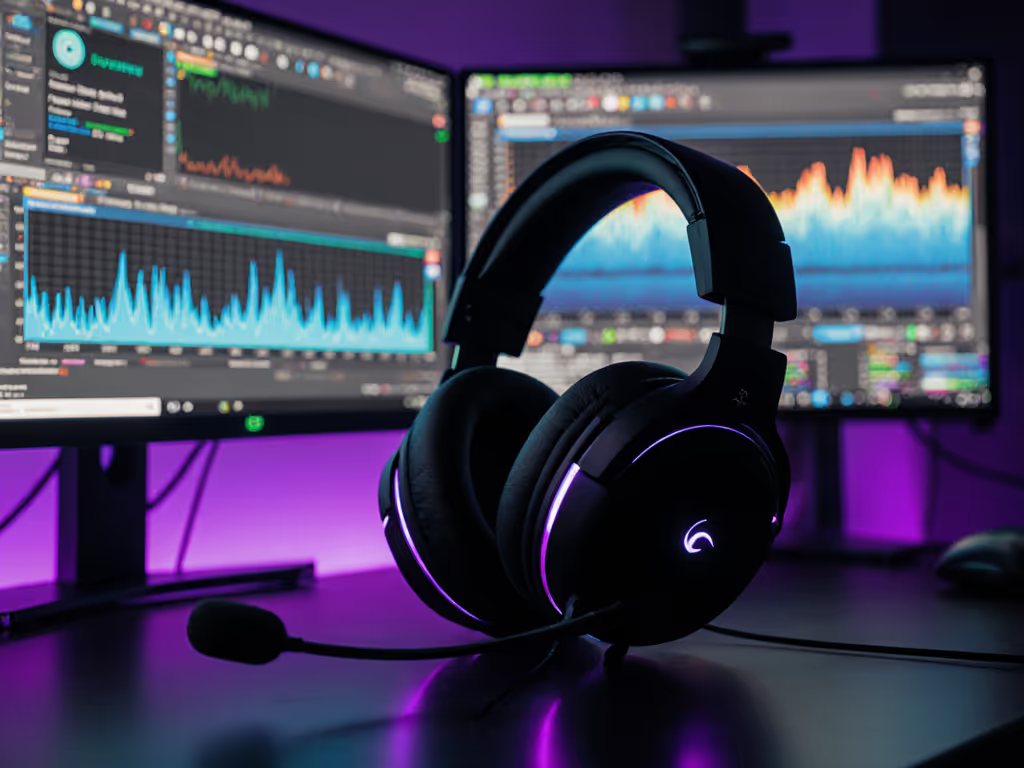
Modern gaming headset technology now offers intelligent, dynamic sound adjustment that adapts in real time. Rather than applying a static EQ curve, these systems listen to incoming game audio and adjust frequency response, spatial cues, and voice clarity on the fly, turning your headset into a thinking tool instead of a passive speaker.
Several approaches drive this evolution:
Frequency-Based Intelligent Enhancement: Advanced headsets use digital signal processing to identify critical in-game audio frequencies and amplify them relative to background noise. For instance, enemy footsteps typically occupy distinct frequency bands that differ from music, ambient wind, or weapon fire. Real-time processing targets those bands selectively, bringing footsteps into sharp relief without boosting everything, a technique that has been shown to improve competitive reaction times and audio-based decision-making.[4] You hear the crucial cue, not a muddied wall of sound.
Spatial Audio with Head Tracking: Systems like Logitech's Immerse integrate AI-driven head tracking via any standard webcam, calibrating spatial audio to your unique ear anatomy.[2] As you move your head during gameplay, the system adjusts the 3D sound field in real-time, so that a sound "behind" you stays behind you, not locked to your camera. This personalization works because the algorithm learns your individual HRTF (Head-Related Transfer Function), the unique acoustic signature of your ears and head, rather than forcing you into a generic template.[2] The result is spatial audio that feels intuitive and reliable, boosting your ability to locate threats and teammates.
Contextual Game Environment Response: Some headsets employ game environment audio response by analyzing ambient sound characteristics (reverb, echo, noise floor) and dynamically adjusting the mix to suit the acoustic space. In a tight indoor hold, the system might brighten mids to preserve voice clarity. In an open outdoor map with wind, it applies subtle filtering to reduce swash while keeping footsteps crisp. This scene-aware audio processing reduces manual EQ tweaking and keeps your audio performance stable across maps and play styles.
When audio adaptation is paired with glasses-friendly fit design (breathable, replaceable pads; even weight distribution; and clamp force calibrated for both small and large heads), the benefits compound. If you wear glasses or need pressure relief at the temples, check our glasses-friendly comfort picks for models that keep seals without hurting clarity. Research confirms that players using adaptive audio technology report measurable gains in gameplay duration (extending sessions without fatigue), situational awareness (faster threat detection), and team communication consistency.[4]
Equally important: intelligent processing reduces listening fatigue. Because the system amplifies essential frequencies and suppresses masking noise in real-time, your ears work less hard to decode callouts. Sidetone that monitors your own voice with near-zero latency prevents you from shouting, keeping vocal strain low across long sessions. The combination (clarity without fatigue, spatial accuracy, and adaptive responsiveness) restores the performance signal your squad needs to stay coordinated.
Static audio is a performance ceiling. If your headset doesn't adapt to the game, the environment, or your physiology, you're leaving wins and comfort on the table. The evolution of real-time audio processing (from intelligent frequency targeting to personalized spatial audio with head tracking) closes the gap between what you hear and what you need to hear.
When evaluating your next best gaming audio headset, prioritize real-time audio processing capabilities alongside comfort metrics that are actually tested: pad breathability, clamp force tolerance, thermal stability over 4+ hours, and glasses-friendly geometry. Look for systems that offer dynamic sound adjustment across platforms without requiring cumbersome software or forced logins. Verify that spatial audio is personalized, not generic, and that sidetone is adjustable and low-latency.
Your squad's callouts will come through clearer. Your fatigue will drop. And your win rate (the true measure of a gaming audio advantage) will follow. That's not marketing hype; that's the audio foundation reliable teams are already building on.